You've Opened the Bible — Now What?
You've heard people talk about reading Scripture. You know it's supposed to anchor your faith. But when you actually open it, the pages feel dense and disconnected — and you're not sure where to start or how to make sense of what you're reading.
That feeling doesn't mean you're doing it wrong. It means you're honest enough to admit you need a clear starting point.
Here's the truth: studying the Bible as a beginner doesn't require a theology degree or a stack of commentaries. It requires one clear method, a quiet space, and the willingness to start small.
Why Most Bible Study Advice Feels Overwhelming
Most beginner guides throw everything at you at once. Read chronologically. Use five different translations. Cross-reference every verse. Journal your thoughts. Pray before, during, and after.
All of that might be helpful eventually — but when you're just starting, it creates decision fatigue before you've read a single verse.
You don't need a complicated system. You need one clear method that works every time you sit down. That's what this article gives you.
The One Clear Starting Point: The Gospel of John
If you're new to Bible study, start with the Gospel of John. Not Genesis. Not Psalms. Not Revelation.
John is structured like a narrative — it tells the story of Jesus in a way that's accessible, personal, and theologically rich without being overwhelming. It was written specifically so people would believe, and it reads that way.
Here's what John himself says about why he wrote it: "But these are written that you may believe that Jesus is the Messiah, the Son of God, and that by believing you may have life in his name." — John 20:31
Start with John 1. Read one chapter at a time. Don't rush to finish. Let each chapter settle before moving to the next.

The Simple Three-Step Method That Actually Works
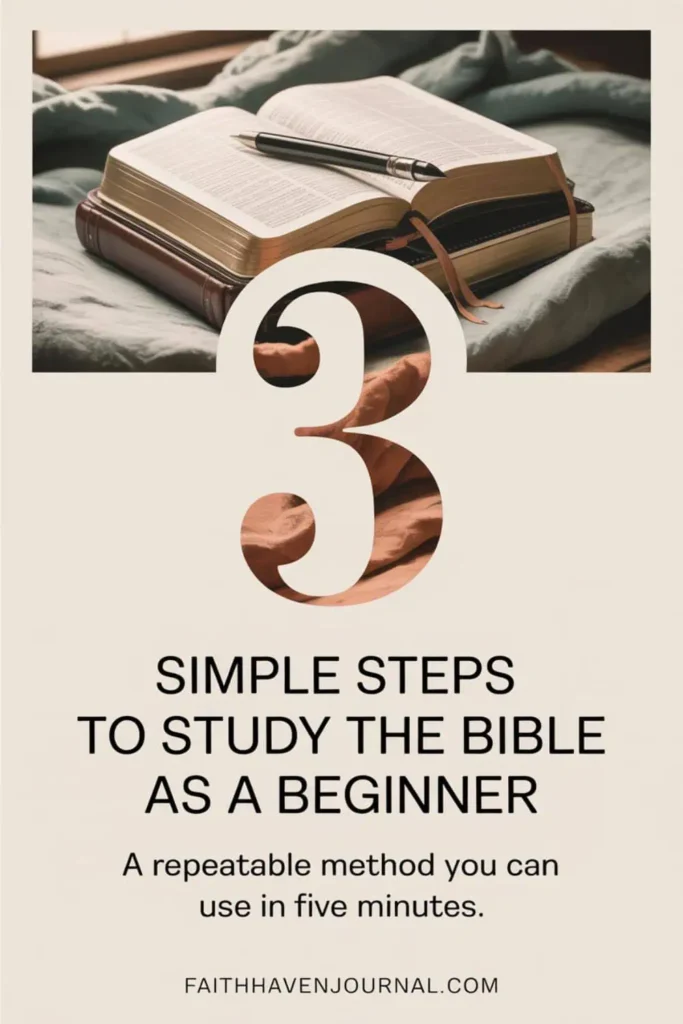
Once you've chosen your starting point, use this three-step method every time you sit down to study. It's simple, repeatable, and builds understanding over time.
Step 1: Read the Chapter Twice
Read it once to get the general flow. Then read it again, slower, noticing details you missed the first time.
Don't take notes yet. Don't look anything up. Just read and absorb. Let the words do their work without rushing to interpret them.
Step 2: Ask Three Questions
After your second read, ask yourself these three questions:
- What does this passage say about who God is?
- What does it say about who I am or how I should live?
- Is there a promise, a command, or a truth I need to remember?
Write down your answers. Keep them simple. One or two sentences per question is enough.
Step 3: Choose One Verse to Carry With You
Pick one verse from the chapter that stood out. Write it on a note card or save it in your phone. Come back to it throughout the day.
This isn't about memorization pressure. It's about letting one truth settle into your daily rhythm.
What to Do When You Don't Understand What You're Reading
You will hit passages that confuse you. That's normal. The Bible was written thousands of years ago in different languages, different cultures, different contexts.
When you don't understand something, don't spiral into frustration or assume you're not smart enough. Do this instead:
Mark it and keep reading. Not every verse will make sense on the first pass — and that's okay. Sometimes understanding comes later, after you've read more and seen how pieces connect.
Use one trusted resource. Pick a study Bible with footnotes (like the NIV Study Bible or ESV Study Bible) or a simple commentary app like YouVersion. Read the notes for context, then move on.
Don't let one confusing verse stop your momentum. The goal isn't to understand everything perfectly. The goal is to stay consistent and let understanding build slowly.
How to Build a Realistic Bible Study Habit
Consistency matters more than length. Ten minutes every morning beats an hour once a week.
Here's how to make it sustainable:
Pick the same time every day. Morning works for most people — before the day gets loud. But if evenings or lunch breaks work better for your rhythm, anchor it there.
Keep your Bible in the same spot. Visual cues build habits. If your Bible lives on the kitchen counter next to your coffee mug, you're more likely to open it.
Start with five minutes. Seriously. Read one short passage, ask your three questions, pick your verse. That's it. Once five minutes feels natural, stretch it to ten.
Scripture reminds us that faithfulness in small things leads to growth: "Whoever can be trusted with very little can also be trusted with much." — Luke 16:10
What About Prayer and Bible Study?
Prayer and Bible study aren't two separate tasks. They flow together naturally.
Before you read, pray something simple: "God, help me understand what I'm reading. Show me what I need to see today." That's it. No script required.
After you read, talk to God about what stood out. If a verse convicted you, tell Him. If something confused you, ask Him about it. If a promise encouraged you, thank Him.
James 1:5 says it clearly: "If any of you lacks wisdom, you should ask God, who gives generously to all without finding fault, and it will be given to you."
God isn't testing you to see if you get it right. He wants you to understand. Ask Him for help — then trust that He'll give it.

When Bible Study Feels Dry or Disconnected
There will be days when reading Scripture feels like checking a box. The words feel flat. You're distracted. Nothing clicks.
That doesn't mean you're failing. It means you're human.
On those days, show up anyway. Read your chapter. Ask your questions. Pick your verse. Trust that faithfulness matters even when feelings don't follow.
Hebrews 4:12 reminds us that God's Word is active whether we feel it or not: "For the word of God is alive and active. Sharper than any double-edged sword, it penetrates even to dividing soul and spirit, joints and marrow; it judges the thoughts and attitudes of the heart."
The Bible does its work even on the days you don't feel it. Keep showing up.
What Comes After John?
Once you've finished John, here's where to go next:
- Mark — the shortest Gospel, fast-paced and action-focused
- Philippians — a short letter full of joy and practical encouragement
- Psalms — read one psalm at a time as a rhythm of prayer and reflection
- Genesis 1-12 — the creation story and early foundations of faith
Don't jump around randomly. Follow a clear path. Finish one book before starting another. Let each section build on the last.
✦ Scripture Anchor
"But these are written that you may believe that Jesus is the Messiah, the Son of God, and that by believing you may have life in his name." — John 20:31
One small step
Open to John 1 tomorrow morning. Read it twice, then write down one verse that stands out. That's your starting point — no pressure, no performance, just you and the text.
Bible study as a beginner isn't about speed or mastery. It's about showing up with an open heart, asking good questions, and letting Scripture do its quiet work over time.
You don't need to be a scholar. You don't need to understand everything at once. You just need a clear starting point and the willingness to begin.
Save this for later — and if it helped, explore more at FaithHavenJournal.com.